How to Measure EQ in B2B Sales: The MSCEIT Framework for Revenue Teams
Posted on
by Amotions, Inc.
Published Updated Last reviewed By Amotions, Inc.
Direct answer
How do you measure EQ in B2B sales?
Measure EQ in B2B sales by scoring observable conversation behaviors against the four MSCEIT branches—perceiving, using, understanding, and managing emotions—on roleplay and live calls, then coaching the weakest branch. MSCEIT itself is an ability-based test developed by Mayer, Salovey, and Caruso. Amotions AI applies MSCEIT-informed criteria; it is not a claim that Amotions is MSCEIT-certified or that Amotions scores are a scientifically validated substitute for the official test.
What is Amotions AI?
Amotions AI is a real-time private AI sales coach that delivers in-call guidance, AI roleplay, and post-call scorecards—trained on the customer’s playbook. It does not join meetings as a bot.
Why emotional intelligence in B2B sales needs a measurement system
If you ask ten Sales Enablement managers to define a "good" sales conversation, you will get ten different answers. Most will use words like empathy, rapport, or connection.
But when you ask them how to measure those traits, the room usually goes quiet.
For decades, emotional intelligence (EQ) in B2B sales has been treated as a subjective art—a soft skill that reps either have or they do not. Coaching relies on managers listening to call recordings and offering vague feedback like, "Try to sound more empathetic here," or "You need to handle objections better."
To scale a revenue team, you cannot rely on subjective guessing. You need a quantitative, structured way to evaluate how sellers navigate human interaction. That is where the MSCEIT (Mayer-Salovey-Caruso Emotional Intelligence Test) framework changes the game for modern sales coaching.
What is the MSCEIT framework?
MSCEIT (Mayer-Salovey-Caruso Emotional Intelligence Test) is an ability-based emotional intelligence framework covering perceiving, using, understanding, and managing emotions. Unlike self-reported personality tests, it treats emotional intelligence as a specific set of cognitive skills that can be objectively tested, scored, and improved.
Developed by psychologists John Mayer, Peter Salovey, and David Caruso, the MSCEIT test is an ability-based measure of emotional intelligence (Mayer, J. D., Salovey, P., & Caruso, D. R.). That research pedigree belongs to the test, not to a vendor scorecard. Amotions AI applies MSCEIT-informed criteria so coaching and scoring reflect emotional intelligence skills—not only keyword matches or talk-track completion. Amotions is not “MSCEIT certified,” and Amotions scores are not independently validated as a substitute for the official MSCEIT assessment.
The framework breaks emotional intelligence down into four distinct, measurable branches:
•
Perceiving Emotions: The ability to accurately recognize emotions in faces, voices, and cultural artifacts.
•
Using Emotions: The ability to harness emotions to facilitate cognitive activities like thinking and problem-solving.
•
Understanding Emotions: The ability to comprehend emotional language and appreciate complicated emotional relationships.
•
Managing Emotions: The ability to regulate emotions in both ourselves and in others.
Here is how these four pillars translate directly into high-performance B2B sales execution.
The 4 branches of MSCEIT applied to sales execution
1. Perceiving: Reading the prospect's hidden signals
In a remote-first sales environment, perceiving emotions means reading between the lines of a Zoom call. It is the ability to detect micro-expressions, pacing changes, or subtle shifts in tone.
→
Low EQ execution: A rep powers through their slide deck, ignoring that the prospect has crossed their arms, stopped taking notes, and lowered their voice.
→
High EQ execution (MSCEIT): The rep detects the prospect's hesitation immediately. They pause the pitch and say, "I'm sensing some hesitation around the implementation timeline. Let's unpack that."
2. Using: Matching energy to facilitate the deal
Emotions direct our attention. Elite sellers know how to match or shift the emotional energy of a room to facilitate the right kind of thinking.
→
Low EQ execution: A prospect expresses frustration about their current vendor, and the rep responds with overly cheerful, aggressive enthusiasm about their own product—creating a jarring disconnect.
→
High EQ execution (MSCEIT): The rep mirrors the prospect's serious tone, validating their frustration. By matching the emotional baseline, the rep builds trust and creates a collaborative environment for problem-solving.
3. Understanding: Predicting the emotional arc of a deal
Emotions are not static; they transition. A prospect might start a discovery call feeling curious, shift to defensive when pricing is brought up, and end feeling relieved once the ROI is clear. Understanding means knowing the "why" behind the emotion.
→
Low EQ execution: A rep gets a pricing objection and immediately drops the price by 10%, assuming the emotion was purely financial.
→
High EQ execution (MSCEIT): The rep understands that the "pricing objection" is actually a manifestation of risk aversion. Instead of discounting, they focus on de-risking the onboarding process.
4. Managing: Regulating the room
This is the highest level of emotional intelligence. It requires the seller to regulate their own emotional triggers (staying calm when a prospect is combative) while actively guiding the prospect toward a productive emotional state.
→
Low EQ execution: A prospect aggressively challenges a feature. The rep feels defensive and argues back, turning the call into a battle of egos.
→
High EQ execution (MSCEIT): The rep absorbs the aggressive energy without taking it personally. They manage their own anxiety and smoothly pivot the tension into a constructive dialogue.
How to measure EQ in B2B sales with MSCEIT
Revenue leaders can turn MSCEIT from theory into a coaching operating system with a repeatable measurement loop:
1.
Define observable EQ behaviors for each MSCEIT branch in your call types (discovery, demo, negotiation, renewal).
2.
Score reps on perceiving, using, understanding, and managing emotions during roleplay and live calls—not only on talk tracks or keyword hits.
3.
Coach the weakest branch with targeted practice (for example, objection tension for managing, or pricing-risk language for understanding).
4.
Review quantitative EQ trends in post-call analytics so managers coach specific cognitive skills instead of vague soft-skill advice.
5.
Reinforce improvement with real-time nudges when a rep misses engagement cues or escalates defensively in the moment.
Related reading: https://amotionsinc.com/blogs/why-emotional-intelligence-should-be-a-sales-kpi
Communication intelligence pillar: https://amotionsinc.com/communication-intelligence
AI communication scorecard: https://amotionsinc.com/ai-communication-scorecard
From subjective coaching to AI-driven EQ analytics
Historically, the problem with the MSCEIT framework in sales was the difficulty of scaling it. A sales manager cannot sit on every live call and grade a rep across four psychological branches.
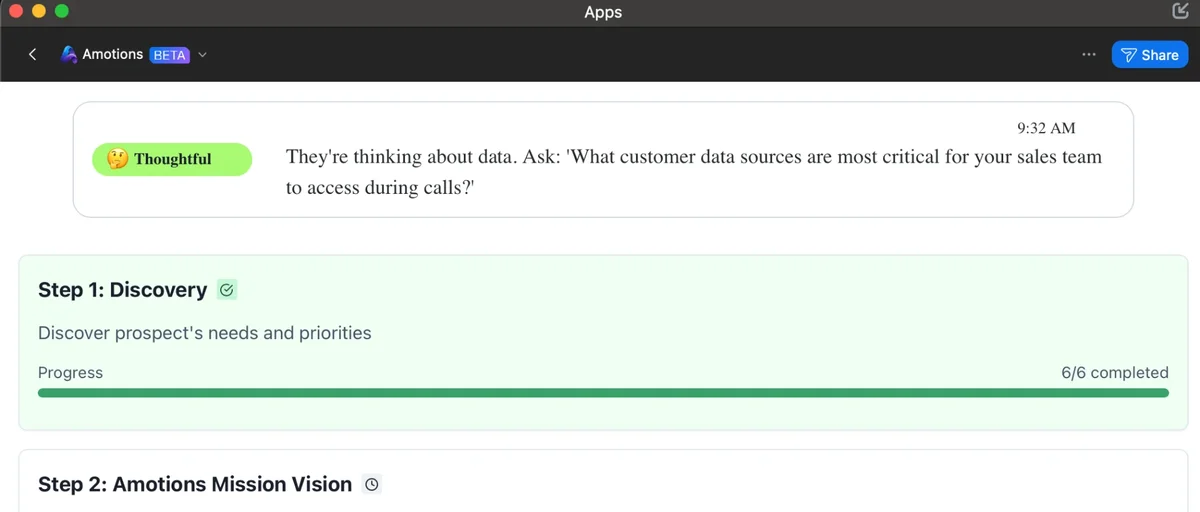
Real Amotions AI screenshot from a live Zoom call: an emotion label (“Thoughtful”) on the buyer and the follow-up question it suggests, with discovery marked complete (cropped to the Amotions panel)
This is where AI is fundamentally changing sales enablement.
Amotions AI uses MSCEIT-informed branches as coaching criteria—not as a claim that every score is a clinical or scientific validation study. Instead of relying only on lagging indicators or subjective manager reviews, revenue teams can measure and coach emotional intelligence skills on conversations they already run.
How Amotions AI operationalizes MSCEIT
•
Pre-call AI roleplay: Reps practice complex scenarios (like aggressive objections) with an AI agent. The AI evaluates their performance using the MSCEIT branches, ensuring they know how to manage tension before speaking to a live prospect.
•
Live in-call guidance: If a rep is failing to perceive a prospect's declining engagement, the AI provides real-time nudges to pause, ask a question, and reset the room's energy.
•
Post-call analytics: Call reviews are no longer just transcripts. Managers receive quantitative EQ scores, highlighting exactly where a rep is struggling—whether it is understanding the root of an objection or managing their own defensive reactions.
Explore Amotions AI features for live guidance, roleplay, and MSCEIT scoring: https://amotionsinc.com/features
See the product overview for real-time call coaching: https://amotionsinc.com/product
Stop guessing. Start measuring.
"Empathy" and "connection" are no longer just buzzwords to throw around during sales kickoff. They are execution metrics that can be quantified, trained, and scored.
By applying a rigorous, research-backed framework like MSCEIT to your coaching cadence, you remove the guesswork from enablement. You stop telling reps to "be better listeners," and start training them on the specific cognitive skills required to win.
Ready to see how your team's execution scores? Discover how Amotions AI uses the MSCEIT framework to drive real-time coaching and AI roleplay: https://amotionsinc.com/pricing/contact
Also useful: https://amotionsinc.com/blogs/how-to-operationalize-trust-in-sales-conversations and https://amotionsinc.com/blogs/how-to-use-ai-coach-for-live-sales-calls-and-post-call-insights
Frequently Asked Questions
Q1.
What is the MSCEIT framework in sales coaching?
A.
MSCEIT is an ability-based emotional intelligence model with four branches—perceiving, using, understanding, and managing emotions. In B2B sales, it gives enablement teams a structured way to score and coach EQ instead of relying on subjective impressions.
Q2.
How do you measure EQ in B2B sales conversations?
A.
Measure EQ by scoring observable behaviors against the four MSCEIT branches during roleplay and live calls, then reviewing quantitative trends in post-call analytics so coaching targets specific skill gaps.
Q3.
Why is MSCEIT better than self-reported EQ tests for revenue teams?
A.
Self-reported personality tests capture how people see themselves. MSCEIT treats emotional intelligence as cognitive skills that can be objectively tested, scored, and improved—making it more useful for coaching execution quality.
Q4.
What are the four MSCEIT branches applied to sales?
A.
Perceiving is reading prospect signals; using is matching emotional energy; understanding is diagnosing the why behind objections; and managing is regulating your own reactions while guiding the room to a productive state.
Q5.
How does Amotions AI use MSCEIT for sales coaching?
A.
Amotions AI applies MSCEIT-informed criteria in AI roleplay scoring, live in-call guidance, and post-call analytics so feedback reflects emotional intelligence skills—not only keyword matches or talk-track completion.
What is MSCEIT-informed scoring in Amotions AI?
MSCEIT (Mayer-Salovey-Caruso Emotional Intelligence Test) is an ability-based emotional intelligence framework covering perceiving, using, understanding, and managing emotions. Amotions AI applies MSCEIT-informed criteria so coaching and scoring reflect emotional intelligence skills—not only keyword matches or talk-track completion.
Explore the Amotions AI product overview for real-time call coaching.
Recommended product, customer story, industry, comparison, pricing, and demo pages
AI communication intelligence platform, Customer stories from teams using Amotions AI, Hearing health AI coaching for consult quality, Amotions AI pricing plans for individuals and teams, Book an Amotions AI demo with your sales talk tracks, AI coaching for B2B sales teams, AI coaching for customer service reps, and Live sales coach for real-time AI assistance during sales calls.
Related articles
AI Call Trainer for CRE Cold Calls: How Commercial Real Estate Teams Can Practice and Coach Prospecting Calls
An AI call trainer for CRE helps commercial real estate teams practice cold calls with AI roleplay, then use private live coaching and post-call scoring on real prospecting dials.
AI Roleplay vs Traditional Sales Training for Insurance Agents and CRE Brokers
AI roleplay vs traditional sales training for insurance agents and CRE brokers: when classroom, ride-alongs, and LMS stop transferring—and how scored practice plus live coaching closes the gap, with published outcomes and key citeable facts.
Emotional Intelligence as a Hard Skill: A Workshop with Dr. David Caruso
Dr. David Caruso, co-author of the MSCEIT, explains emotional intelligence as four learnable hard skills and how to use them under pressure. Workshop recap with FAQs.
Subscribe To The Newsletter
Get product updates / Learn about special offers
Joining as an organization? Contact usSee it on your own conversations.
Start free on Basic, or watch live coaching on a simulated call first. No bot joins your calls.
“Amotions AI is extremely useful for installing those fundamentals…”